Extending the Basis Trade to Equities
Ethena has operated the largest delta-neutral collateral pool in all of crypto for several years, with a peak crypto basis allocation of greater than ~$8bn during 2025.
The mechanism for the basis trade is unchanged across BTC, ETH and SOL: hold spot, sell the perpetual, and collect the funding premium that leveraged longs pay to maintain exposure. The framework applies to any market with a liquid spot asset, a liquid perpetual, and a structural funding premium.
Two things have happened over the past eight months:
1/ Following the collapse in market-wide open interest on 10th October 2025, the crypto basis premium had compressed during this bear market to its lowest sustained level since perpetuals became an institutional instrument,
and
2/ Deep perpetual markets referencing real world assets, including equities, have emerged on the same venues Ethena already executes, paying multiples more than the crypto rate - on an underlying asset base measured in the hundreds of trillions (i.e., equity markets).
Equity perpetual futures capacity now meets Ethena’s conditions at institutional scale.
The equity perpetual basis trade became viable
Equity perpetuals were first listed on Hyperliquid in December 2025, opening with eleven contracts and ~$90m of open interest. Binance followed at the end of January 2026 with a single Tesla contract and ~$11m of open interest.
For the first quarter of this year, these markets were still nascent with open interest below the minimums Ethena requires to execute, and experienced volatile funding rates and pricing. However, as tokenized equities became one of the industry’s biggest and most exciting growth stories, liquidity and open interest across contracts drastically improved on all venues in a short amount of time.
As of 11 August 2026, open interest across all venues hit $6.2bn on equity perpetual futures. Combined open interest grew tenfold between 1 March and 11 August alone.
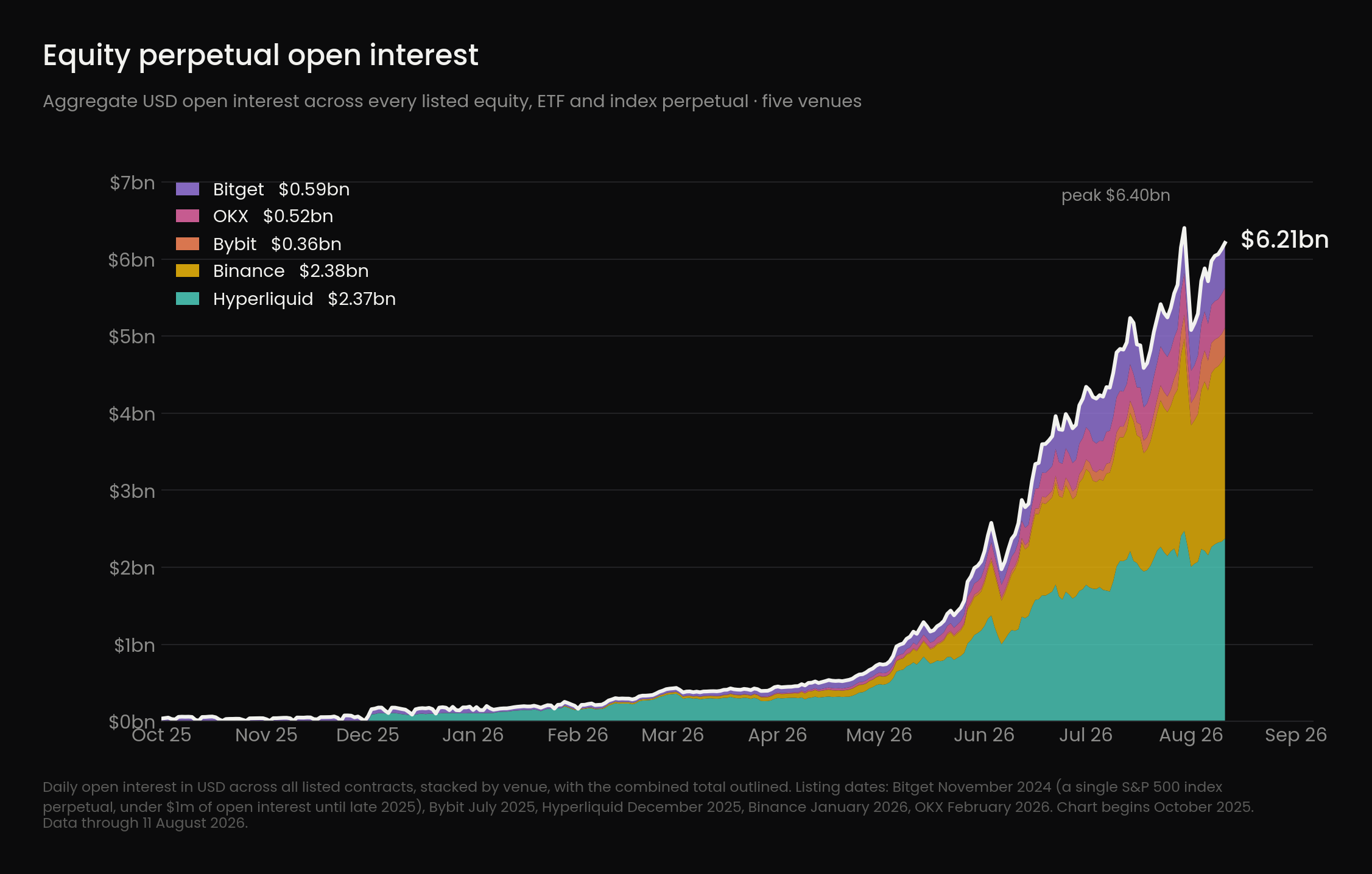
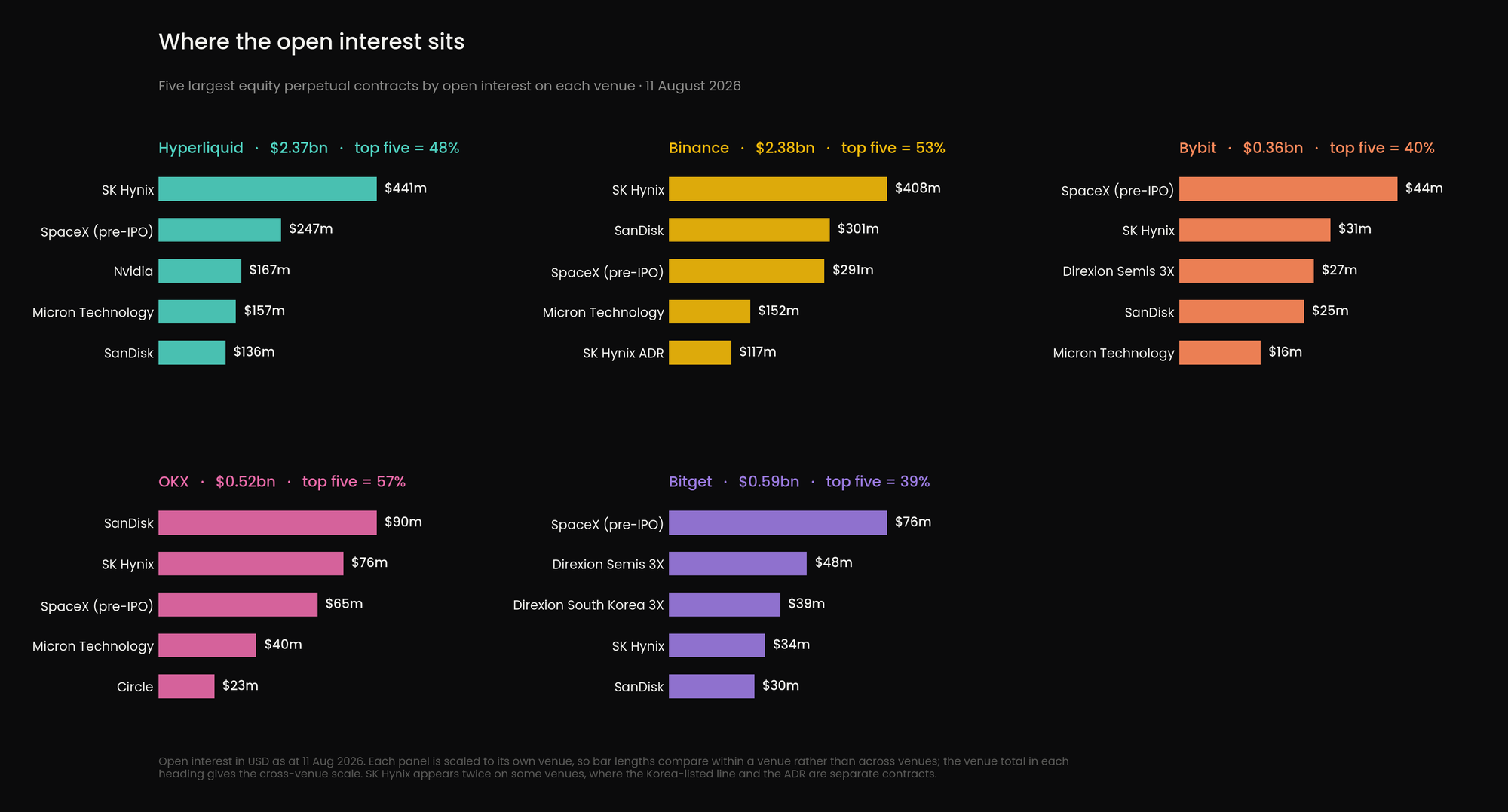
Open interest today is heavily concentrated in the memory and AI hardware sectors, which accounts for roughly half of the book on both venues. SK Hynix alone represents 18% of Hyperliquid’s equity open interest, while Micron, SpaceX, Nvidia and SK Hynix ADR contract fill out the remainder of the top 5. The top 5 on Binance are the same with the exception of Sandisk in place of Nvidia.
The crypto premium has compressed
The growth of equity perpetuals in the first half of this year is a stark contrast to the compression of the crypto basis trade.
Bitcoin’s open-interest-weighted funding rate averaged 11.0% annualised across 2024, and the basis trade made up the majority of USDe’s backing asset split during that period. For 2025 funding rates compressed to 4.9%, and as of 11th August 2026, year to date they have averaged just 2.2% (2.6% over the last 90 days).
As a result, the crypto basis trade represented just 1% of USDe backing assets up until two weeks ago. However, as crypto market sentiment improved recently, crypto funding rates picked up again and represent 13% of USDe backing today.
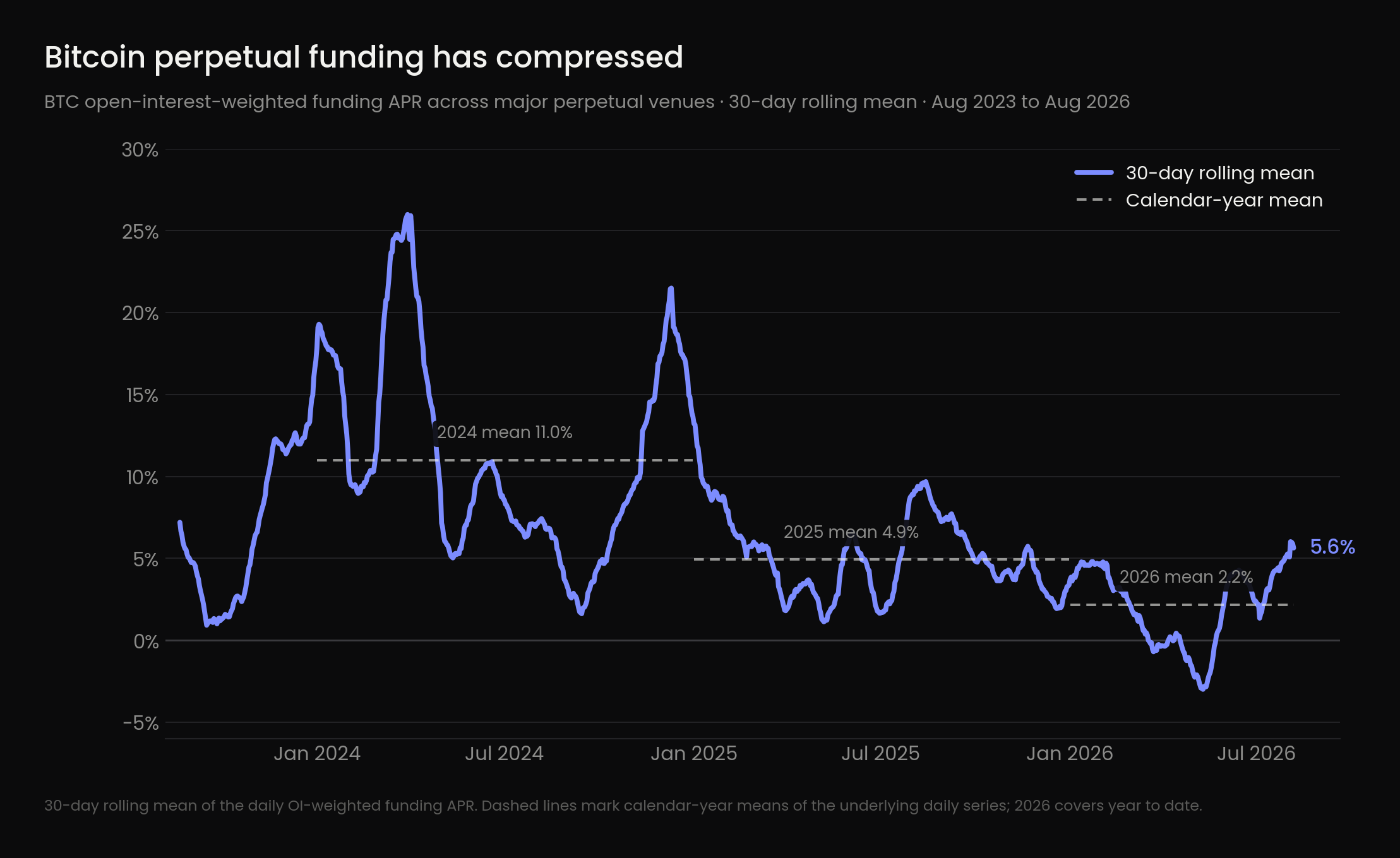
The compression in crypto funding was either signalling a bear market or a market maturing. What was once a meaningful demand imbalance to go long crypto assets with leverage had disappeared, while stories of retail investors and funds chasing equity leverage had been increasingly prevalent in the stock market.
However, the recent improvement in crypto funding rates seem to signal that appetite for long side leverage has returned.
Retail leverage found a new expression
The demand pattern in equity perpetuals is one-directional in a way that echoes crypto in 2020/2021 and when Ethena first launched.
Over the window in which both Binance and Hyperliquid established strong liquidity in equity perpetuals (minimum $250m total open interest), funding was positive on 94% of days on Hyperliquid and 97% of days on Binance. Longs pay persistently, and the market clears at a premium rather than oscillating around zero. These figures closely mirror the conditions in the crypto markets when Ethena launched.
Retail on crypto venues wants long exposure to the AI buildout and cannot easily get it. The perpetual is becoming the de facto instrument to express a levered view on the underlying of all assets, not just crypto.
Equity Perp Funding Rates
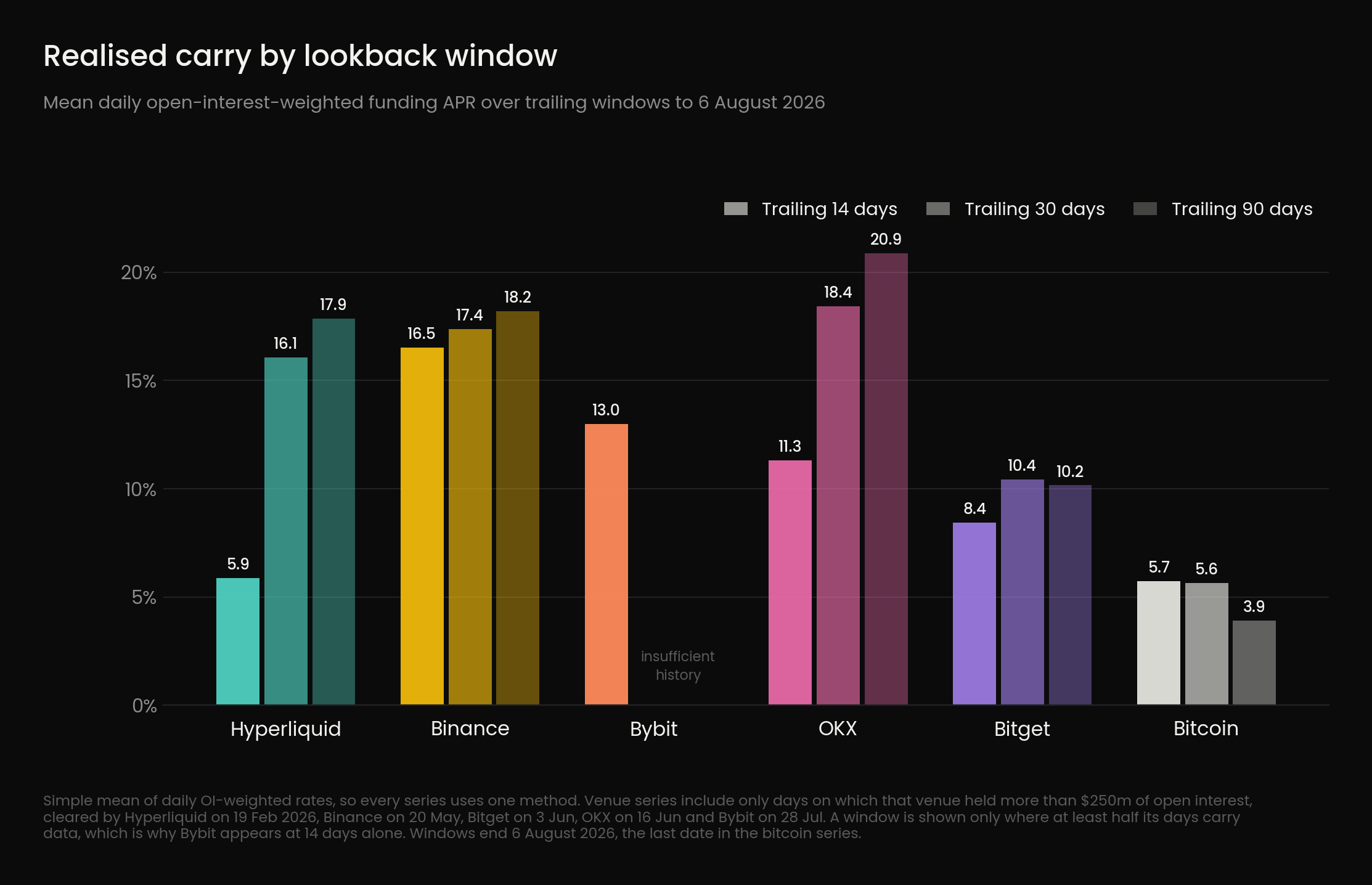
Across 20 May to 11 August 2026, Hyperliquid’s open interest weighted funding averaged 14% annualised and Binance’s averaged 17.5%. Bitcoin OI weighted funding rates averaged 4.1% over the same period.
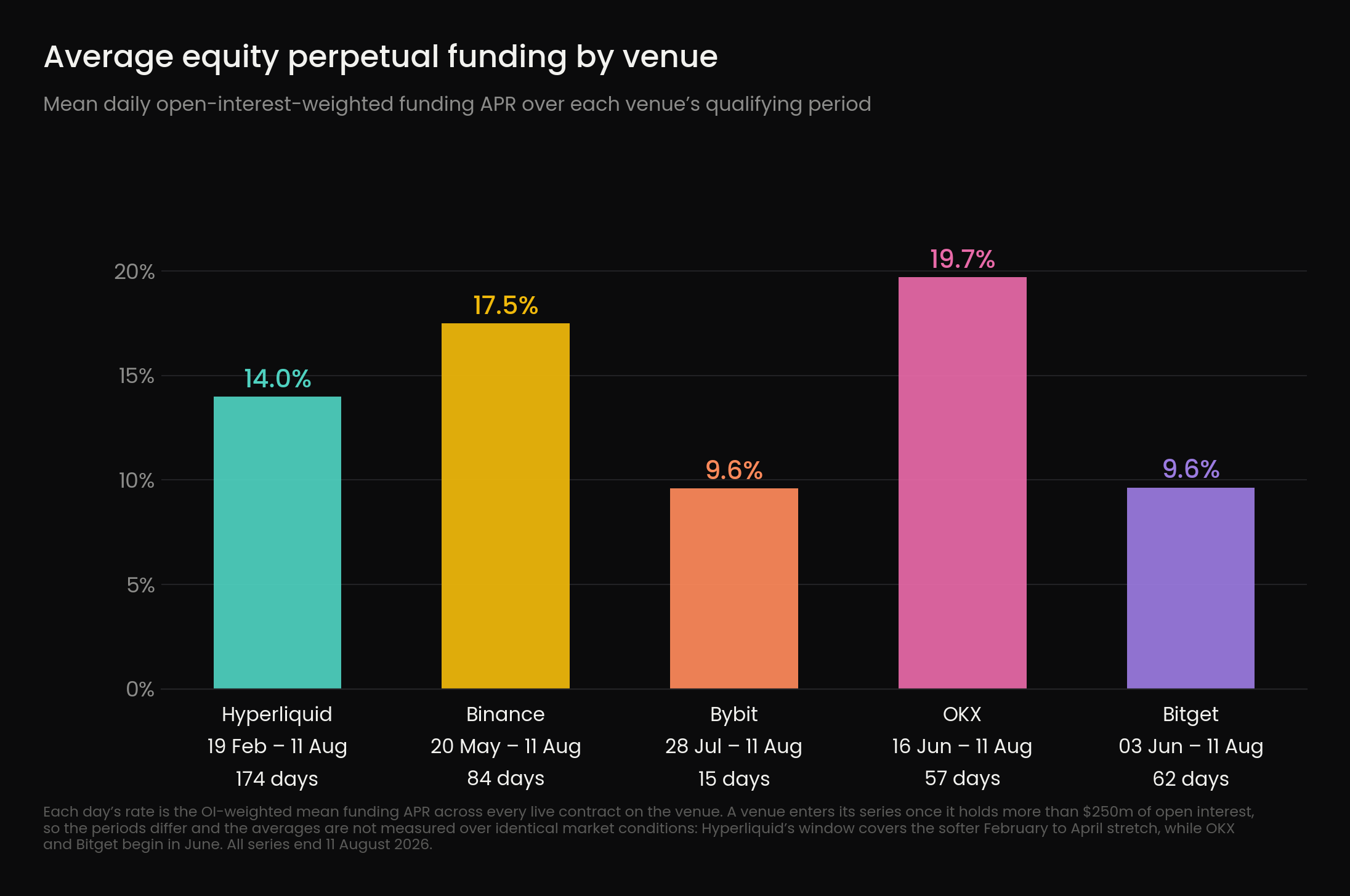
While equity funding rates have moved closer to crypto funding rates in August, in the prior three months the average spread between the two was as high as 19%.
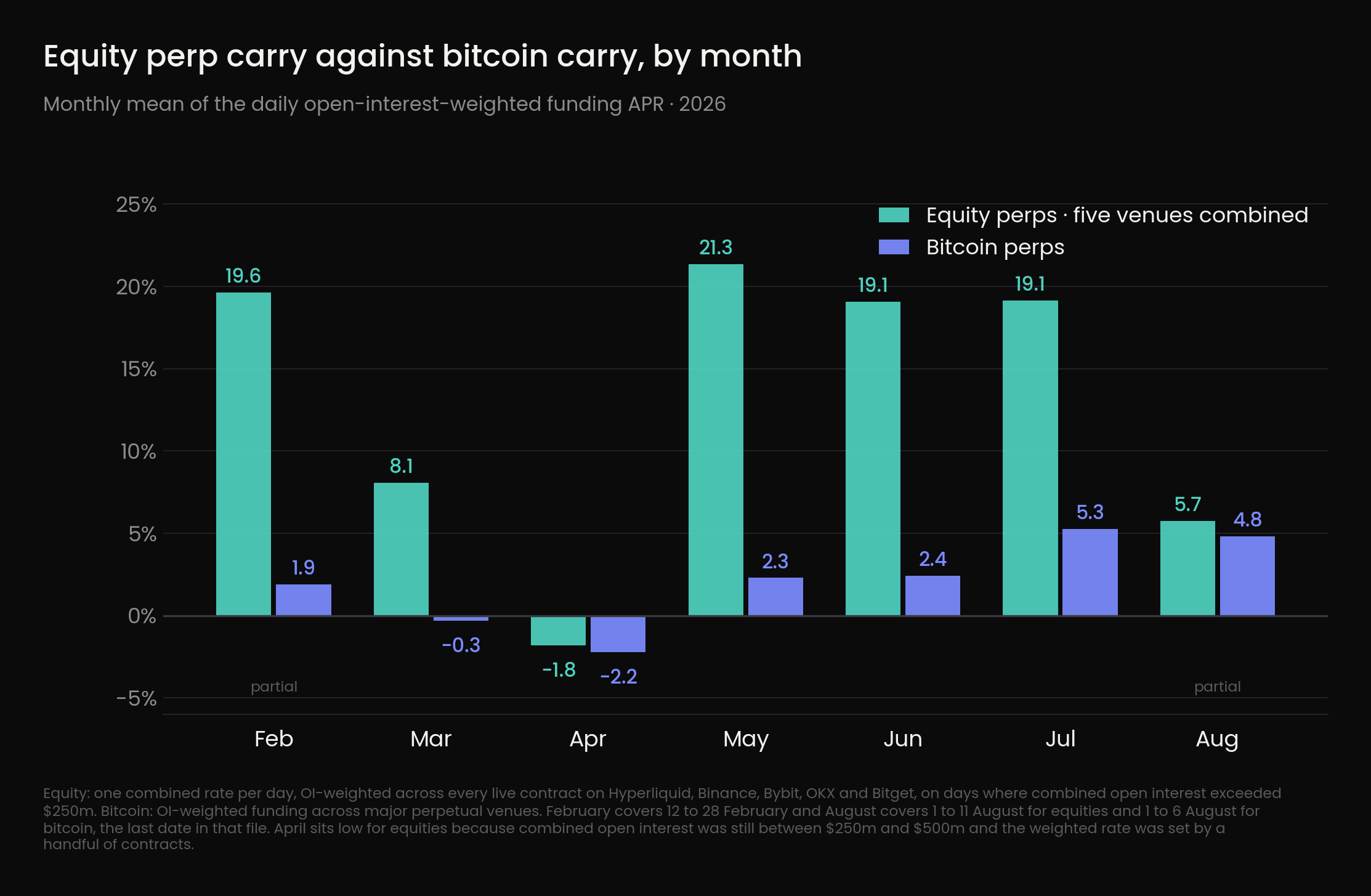
The funding rate gap holds across every timeframe. Over the trailing thirty days the equity venues paid as high as 18.4% against bitcoin’s 5.6%.
The histogram of funding rates across both equity and bitcoin perpetuals demonstrates the change in demand across the two markets over the last year. Bitcoin funding rates have concentrated around the risk free rate, with a median of 3.9%, including many observations around 0% and negative.
The tails aren’t as long or fat, as crypto perpetuals have been traded for >5 years now, compared to the long tails of the more nascent equity perpetuals on either side.
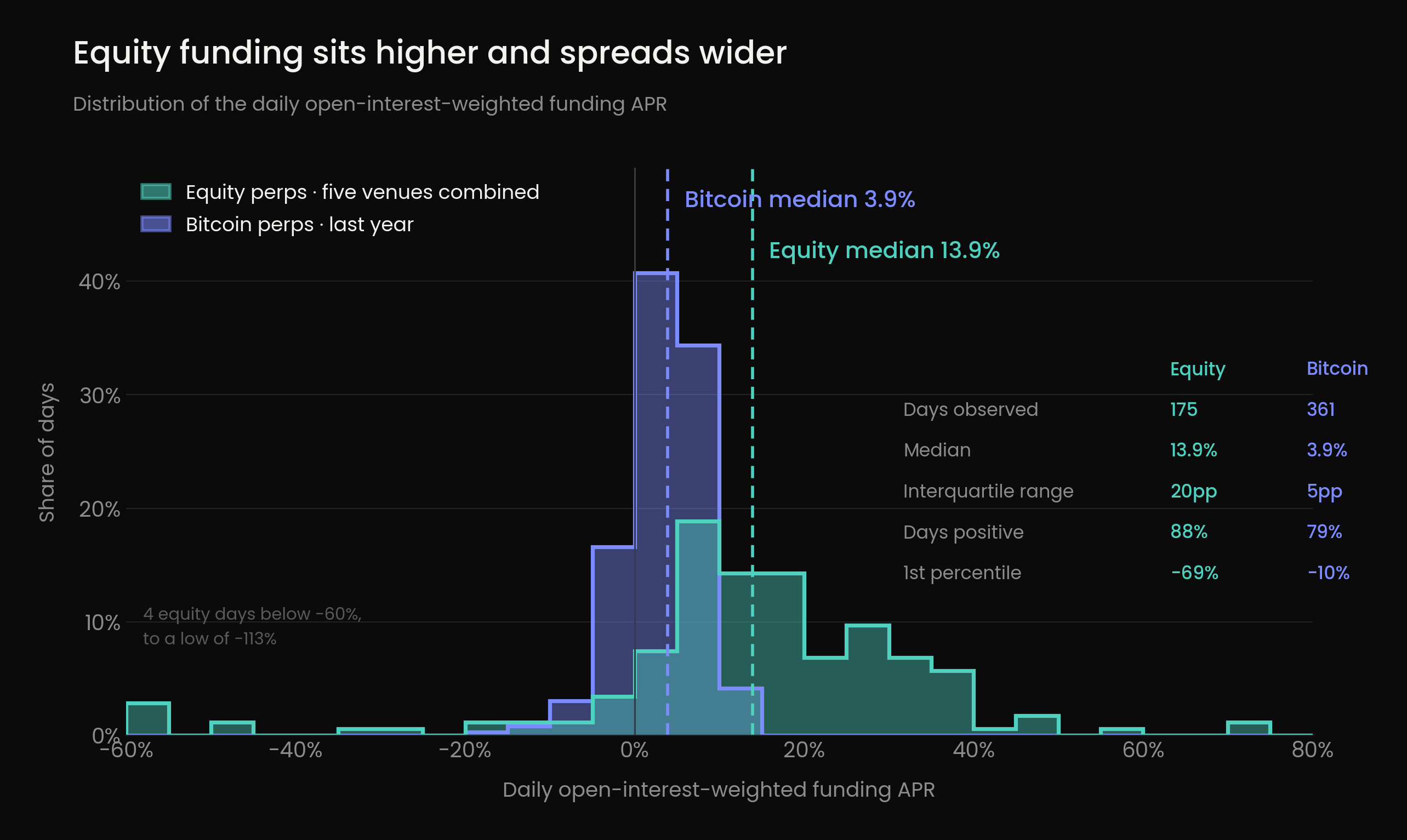
Equity perpetuals funding rates have been more dispersed, but are consistently dispersed across positive values, with many observations recorded above 10%. The median of equity funding rates is 13.9% vs 3.9% for Bitcoin, with 88% of positive values for equity funding rates vs 79% for Bitcoin.
The premium is uncorrelated with crypto
For a portfolio that already earns crypto funding, the question is whether equity funding is a genuinely differentiated return stream or the same exposure in a different instrument.
The data shows it is differentiated. Across the selected window, the daily correlation between bitcoin funding and equity perpetual funding is +0.08 on Hyperliquid and +0.14 on Binance - i.e near zero correlation.
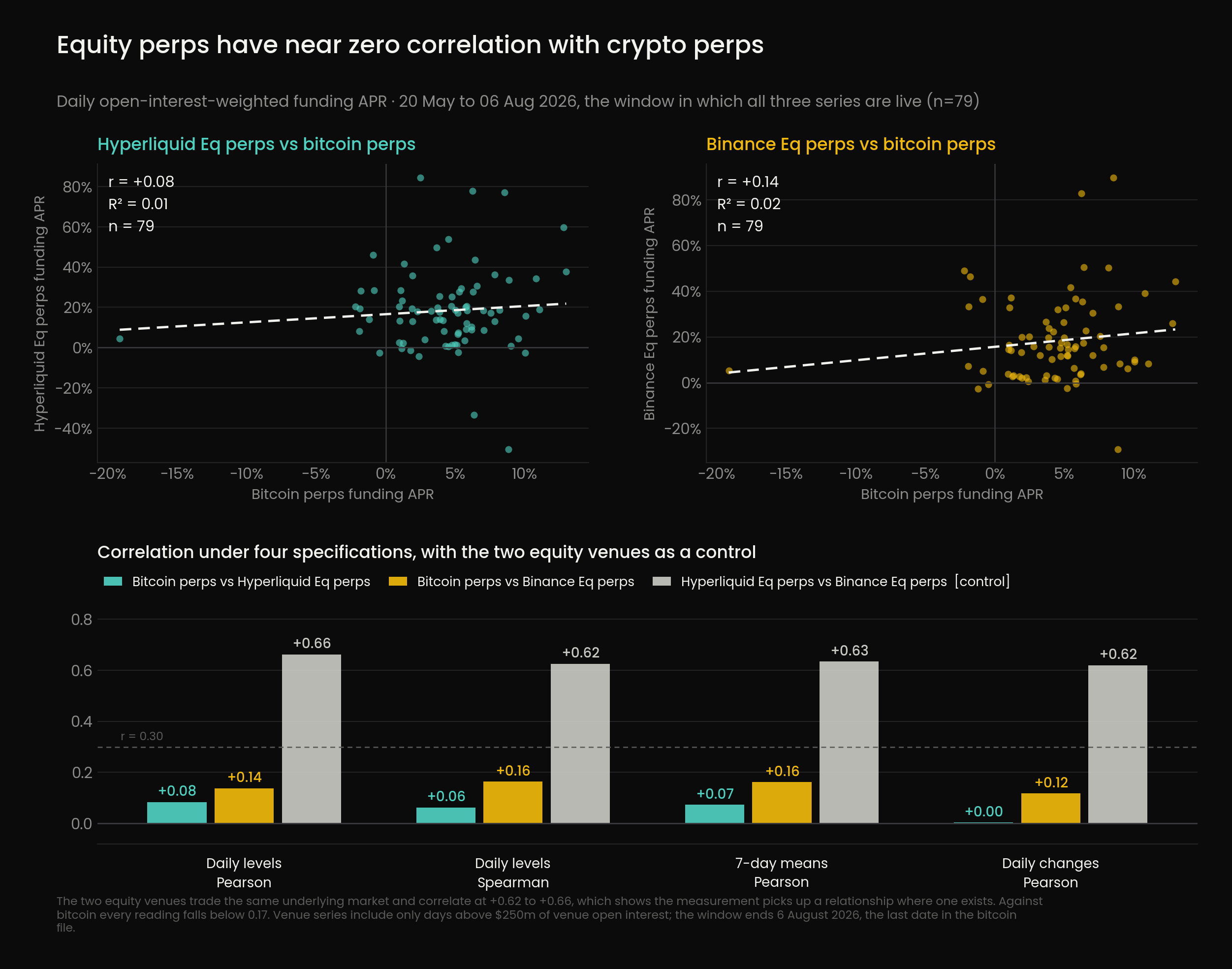
Hyperliquid and Binance equity funding rates correlate with each other at +0.62 depending on specification, which is to be expected.
The ceiling is considerably higher
Equity perpetuals carry $6.2bn of open interest today against roughly $94bn across the crypto perpetual futures market. The equity perp market is early, but the potential size of the equity perp market is far larger.
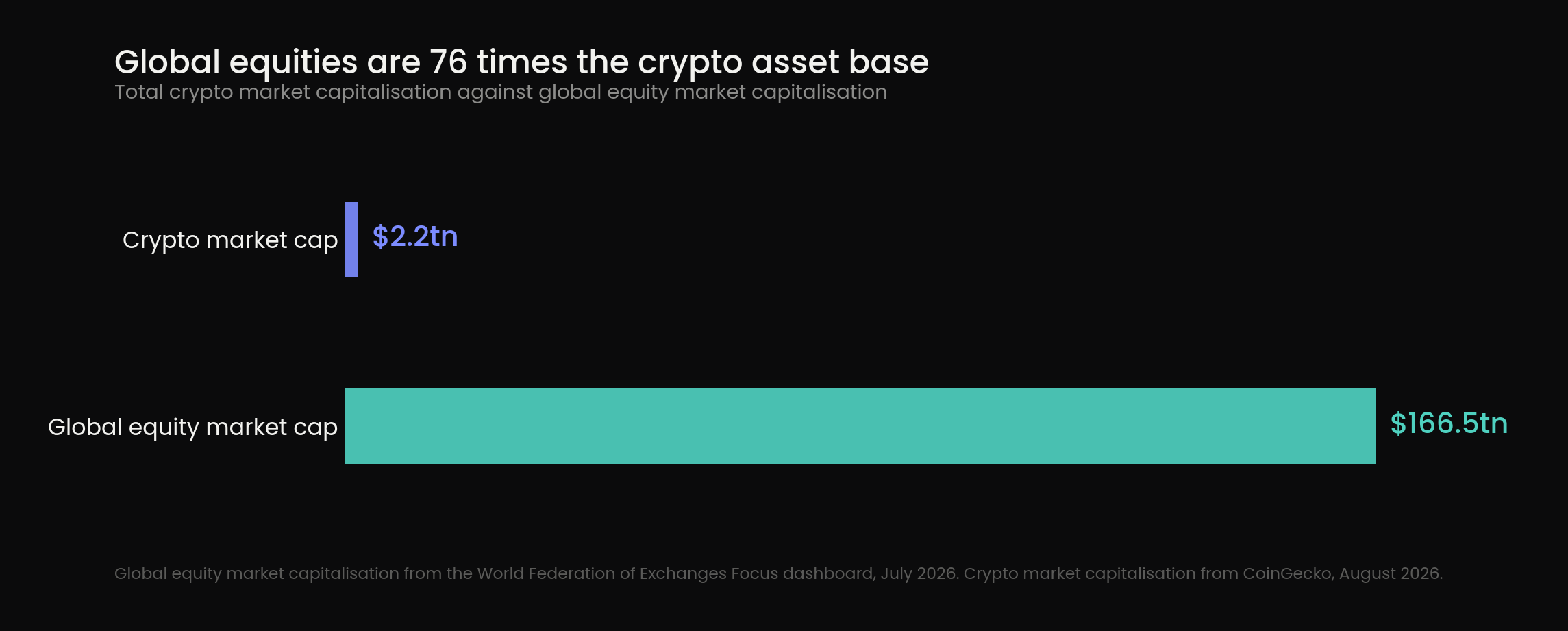
Today’s crypto perpetuals market is a rounding error against the potential of equity perpetuals. Total crypto market capitalization sits at roughly $2.2tn, far smaller than global equity market cap which reached $166.5tn in July 2026.
The appetite is already demonstrated
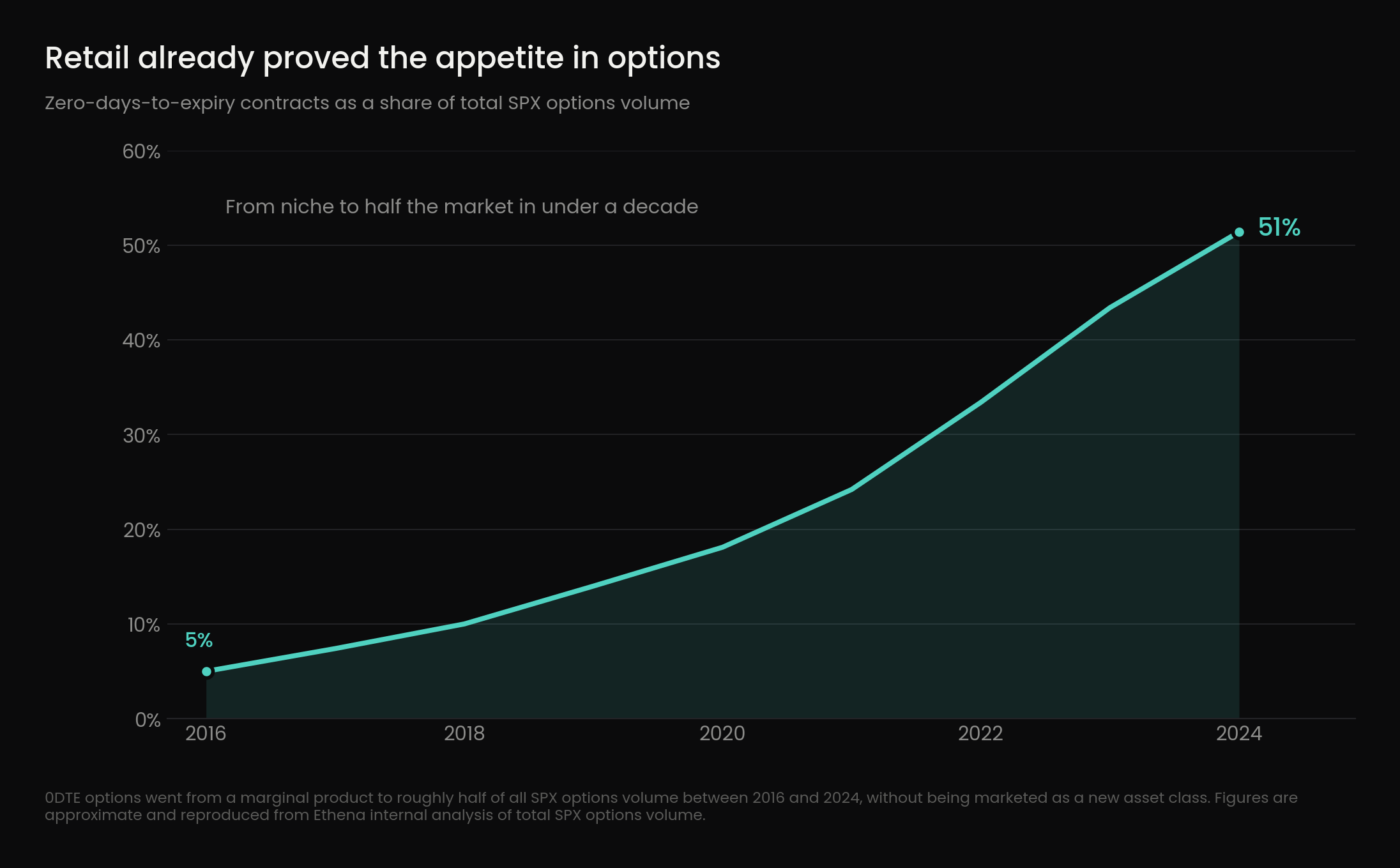
Equity markets have run this experiment once already, in options. Zero day to Expiry (0DTE) options went from a niche instrument to 51% of all SPX options volume in under a decade. That is proof of the enormous appetite for short-dated, leveraged directional risk in equities and the perpetual future instrument is arguably a better expression of those needs.
Options have been retail’s default way to express a view on equity price action, for both indices and individual large-cap names. Traders are frequently right on direction and still lose to pricing structure of the option and to the makers on the other side. Theta decay, spread, and the cost of rolling all sit between a correct call and a profitable one.
Perpetuals provide a strictly better primitive for expressing short-term views. They are also more efficient markets in their own right: a trader’s choice is binary: long or short, and they do not need to work out fair pricing for a particular option strike.
Crypto gives a reference point for how large a perpetual market can grow relative to the underlying market. Crypto perpetual open interest peaked at 2.6% of crypto market capitalisation in September 2025 and sits near 2.0% today.
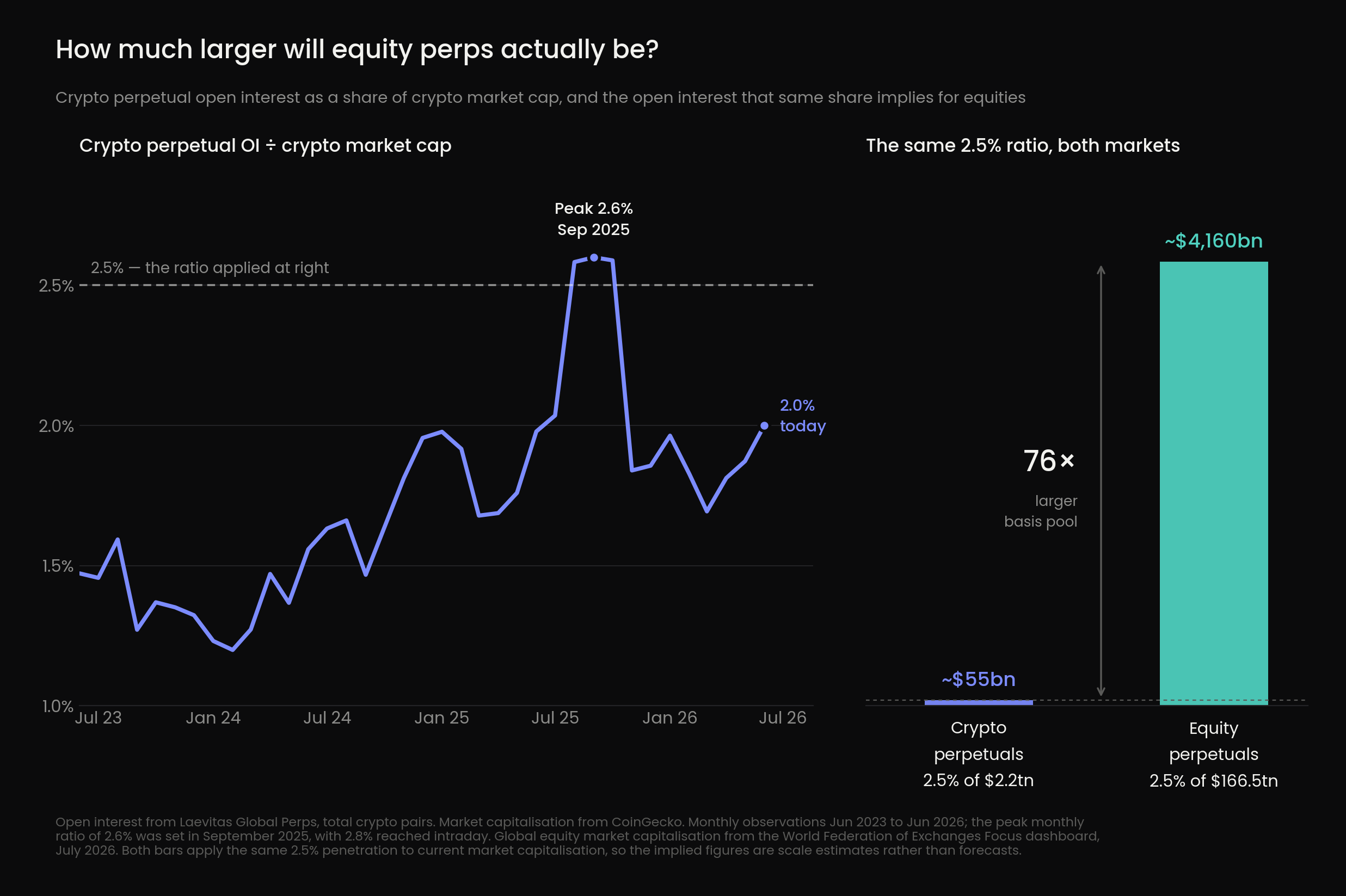
Applying that same 2.5% penetration to a $166.5tn equity market implies roughly $4tn of potential equity perpetual open interest, compared to a peak crypto OI of $110bn. That is a basis market close to 40 times larger, running the same trade just on a bigger market.
Why Ethena
Running this trade requires the infrastructure Ethena already operates.
Delta-neutral execution at scale. Ethena has managed multi-billion-dollar hedged books across venues through several full market cycles, including periods of acute stress.
Off-exchange settlement. Collateral sits with regulated custodians rather than on the exchange, which is the same structure Ethena applies to its crypto backing and the reason venue failure does not translate into principal loss.
A gated onboarding framework. Every asset and market market entering the backing portfolio clears defined thresholds for spot liquidity, perpetual depth, funding persistence and venue standards for custody, settlement and counterparty risk, all subject to Risk Committee analysis. Positions are sized against those limits and monitored continuously.
Trust at scale. Ethena is the one of the only delta neutral operators that has scaled to >10bn in size, facilitating over $30bn of mint and redeem flows with zero losses impacting the protocol. Equity perpetuals represent a larger opportunity than crypto perpetuals, and Ethena is best positioned to capture that growth at scale.
The logic for extending into equity basis trades is a direct application of what Ethena already does. The same methodology that governs BTC, ETH and SOL governs every new asset, and equity perpetuals now clear the same bar.
Footnotes
Open interest floor. All funding charts exclude days on which a venue held under $250m of open interest in equity perpetual futures. Below that level the weighted rate was set by some sub-$20m contracts, several of which printed volatile funding rates due to low liquidity. Hyperliquid clears the floor on 19 February 2026 and Binance on 20 May 2026.